

When the Spirit of Cantonese Dim Sum Merges with Neoclassicism...
Source: Music Weekly
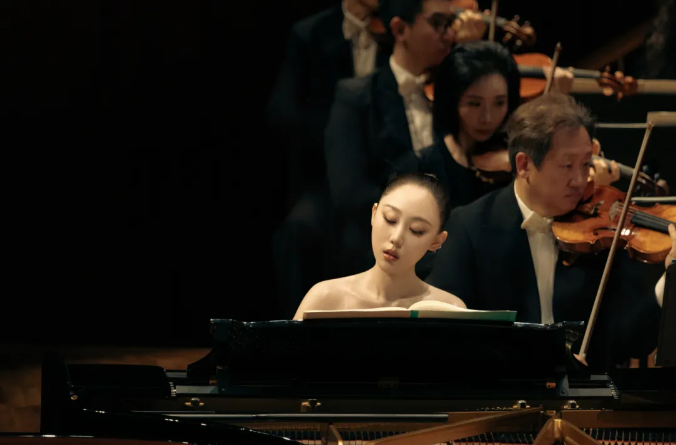
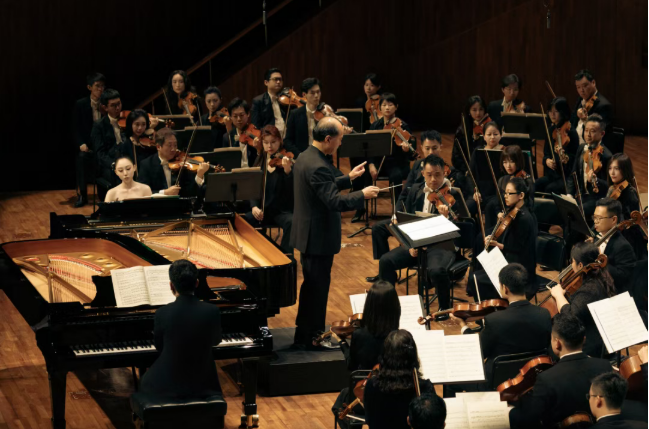
Around the Summer Solstice, the heat of the Greater Bay Area was punctuated by thunderstorms. At the same time, the classical music scene was alive with the vibrancy of the summer season. One of the most notable events was the concert at the Xinghai Concert Hall on 22 June, where conductor Zhang Guoyong led the Guangzhou Symphony Orchestra in a performance of Shostakovich's Symphony No. 10 in E minor, Op. 93, commemorating the 50th anniversary of the composer's death.The surprise of the evening came from Kong Jianing and Catherine Zeng, two young pianists who presented French composer Francis Poulenc's Concerto for Two Pianos in D minor. The pairing of "Shostakovich + Poulenc" was a rare and intriguing programme.
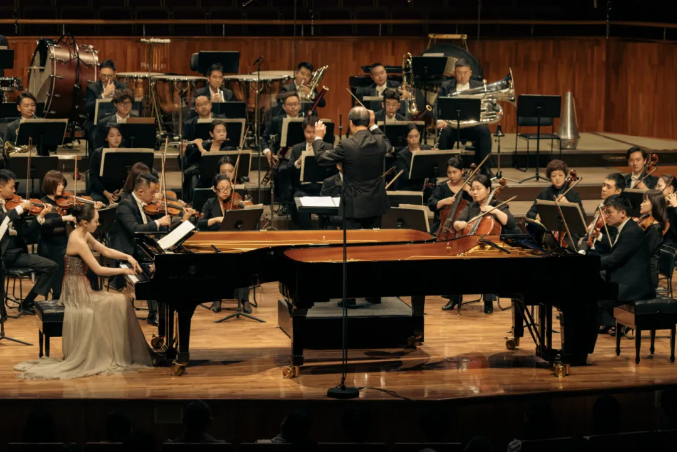
The concert opened with Saint-Saens' Danse Macabre, a celebrated symphonic poem of French Romanticism. As an appetiser, however, it was rather bold – full of the playfulness and grotesquery characteristic of 19th-century Romantic music. The orchestra proved entirely at ease with this repertoire, performing with lightness and assurance. Similarly French in flavour, the next piece - Poulenc's Concerto for Two Pianos in D minor - was quite a different affair. This work belongs to the Neoclassical style of the 20th century, with less of Romanticism's fantasy and lushness and more of a fresh, crisp sensibility. Though its musical structure departs from the conventions of sonata form, it focuses instead on pianistic brilliance, creating a unique dialogue with the orchestra.
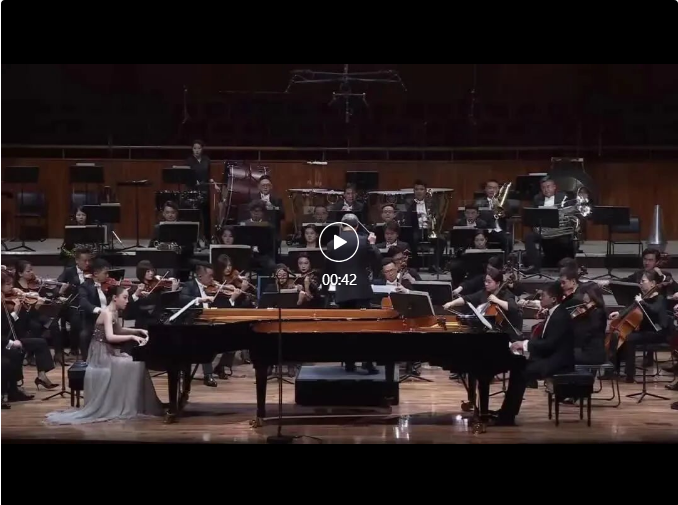
Kong Jianing and Zeng Beibei performed with remarkable unity and precision. For Zeng, who was then a third-year undergraduate at the Royal College of Music, her control of rhythm and dynamics was impressively assured – her coordination with the orchestra was seamless. From the two forceful opening chords of the first movement, the music radiated an air of joyful energy. The second movement brought a Mozartian lyricism and tranquillity, while the finale unfolded in a spirited, virtuosic chase. The orchestra drove the buoyant energy forward, with notes flowing nimbly beneath the pianists' fingers – the effect was delightfully animated.The two pianos accompanied each other with impeccable rapport; the music was vibrant, sweet, and captivating.
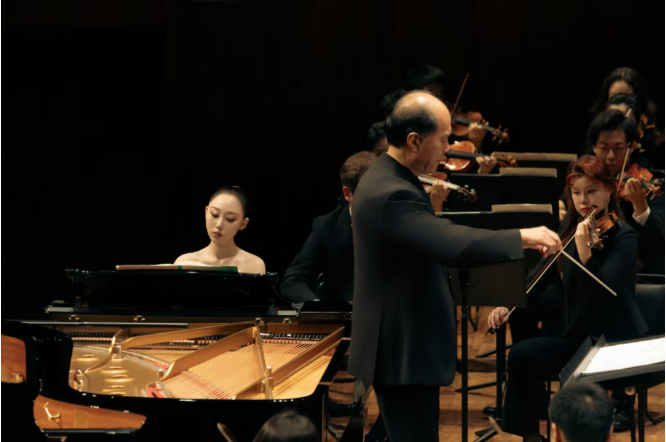
While Kong Jianing's playing was clearly the dominant voice, Zeng Beibei demonstrated strong musical instincts, pouring her expressive sensibility into Poulenc's idiom. She responded actively to the orchestra, maintaining the clarity and subtlety of her own part, and achieving an outstanding level of completion. Under the orchestra's luminous support, the duo's performance sounded grand and noble. Each musical gesture drew the listener's attention, immersing them in the sound world long after the final notes faded.
Interestingly, both pianists share a cultural affinity with the Greater Bay Area. Kong Jianing jokingly compared their teacher-student collaboration to the classic Cantonese dim sum combination – "one pot of tea and two dim sum dishes" – like the crispness of har gow (shrimp dumplings) meeting the soft warmth of lau sha bao (custard buns), a natural and harmonious fusion. Zeng Beibei remarked that she sought to "infuse the breath of Lingnan culture" into her interpretation – a statement that reveals her conscious artistic agency.
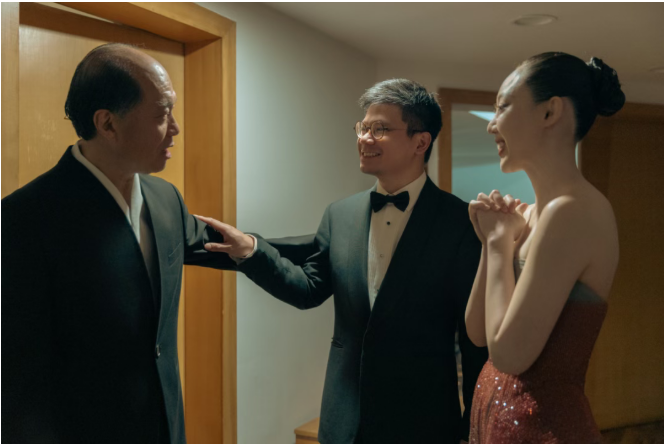
Those familiar with Lingnan culture would recognise that "one pot and two dim sum" is a highly stylised culinary ritual, and this Cantonese aesthetic resonates remarkably with the French Neoclassical spirit of a century ago. The performers' subjective exploration – embedding cultural dimensions within piano interpretation – adds rich layers of imagination and aesthetic nuance to their partnership, especially noteworthy for a teacher and student from the same institution.
In the second half, Shostakovich's Symphony No. 10 in E minor – a substantial and deeply autobiographical work – was conducted by Zhang Guoyong, a renowned contemporary interpreter of Shostakovich. The audience's anticipation was palpable. The complexity and profundity of Shostakovich's symphonies present considerable technical challenges for both conductor and orchestra; without coherent structural vision and judicious artistic treatment, the near-hour-long architecture risks becoming tedious. His symphonies stand as a distinctive landscape in 20th-century art music, with a symphonic language that diverges markedly from the Western Classical-Romantic tradition. It was clear that the conductor and orchestra had engaged in meticulous preparation. The first movement unfolded with sustained patience and conviction – a sweeping, Russian-influenced musical breadth – culminating in a sudden storm-like climax just before the movement's close, a visceral thrill that can only be fully experienced live. The second movement followed with a brutal, relentless march that persisted to the very end, leaving a visceral and indelible impression. The third and fourth movements revealed greater textural variety, with various instrumental sections fully showcased, demonstrating the orchestra's rich expressive palette. Zhang Guoyong's understated yet authoritative conducting allowed the audience to fully immerse themselves in the symphonic sonority, while also sensing the formidable power of Shostakovich's complex artistic personality.
Video:
"It has been a long time since I last heard such heavenly piano playing—like a breeze on an early summer night, carrying the poetry and grace of a returning young woman toward the ancient Forbidden City. A rare blend of intellect and innocence, the music flows through youthful fingertips, bringing forth a Zen-infused, Eastern empathy that melts the classical into the ordinary. It lets an angelic heart encounter love and beauty—and all that is good comes as promised, walking alongside us like a shadow. This is the rich, nuanced inner world and pianistic vision that the prodigy Beibei has revealed to me." (by Zhu Hai)